Cardiff Services

Cardiff Services
Call for enquiries +91 98190 00640
Contact Us

Uncategorized

Received an ROCย Strike-Off Notice?

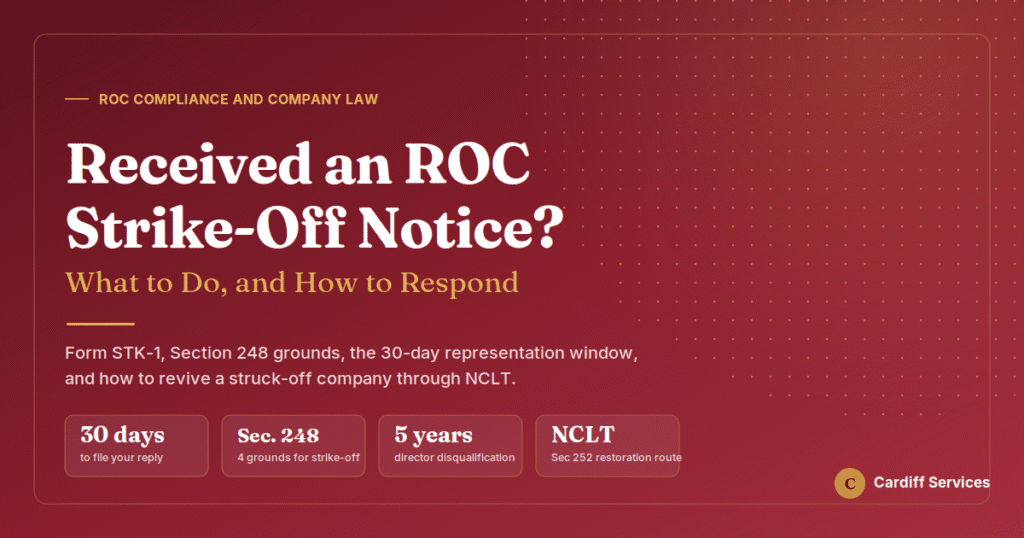
Home / Blog / ROC Strike-Off Notice ROC Compliance Received an ROC Strike-Off Notice? What Form STK-1 under Section 248 means, how to file a written representation within 30 days, what happens if you don’t respond, and how to revive a company already struck off. Cardiff Services 22 September 2026 13 min read Section 248Form STK-1Section 252NCLT RestorationMCA At a glance The response journey 1 VerifyDay 1 Check the MCA master data and identify which of the four Section 248(1) grounds is cited. 2 File overdue returnsBefore you reply Clear the AOC-4 and MGT-7 backlog so the representation has evidence behind it. 3 Submit representationWithin 30 days A written reply to the Registrar with supporting documents and a board resolution. 4 Track the outcomeOn MCA portal Status stays ‘Active’ if accepted โ€” or moves to Form STK-5 if the Registrar isn’t satisfied. An STK-1 notice is a warning, not dissolution โ€” the company stays legally alive until Form STK-7 is published. 30 daysto file a written representation after Form STK-1 4grounds under Section 248(1) that trigger a notice 5 yearsdirector disqualification under Section 164(2) 20 yearswindow to apply for NCLT restoration under Section 252(3) An ROC strike-off notice is a formal communication from the Registrar of Companies proposing to remove a company’s name from the official register because it appears to be inactive or non-compliant. If your company has received Form STK-1 under Section 248(1) of the Companies Act, 2013, you have thirty days from the date of the notice to file a written representation, along with supporting documents, explaining why the Registrar should not proceed with the strike-off. This notice is not the same as dissolution โ€” the company is still legally alive until the Registrar actually publishes Form STK-7 in the Official Gazette. But ignoring it triggers automatic strike-off, freezes the company’s bank accounts and assets under Section 250, and can disqualify every director from holding a directorship in any other company for five years. What you have now Form STK-1 โ€” the notice A warning that the Registrar intends to strike the company off. The company remains “Active” on the MCA portal. Law Section 248(1) Sent to Registered office + every director Your window 30 days to respond What happens if you don’t respond Form STK-7 โ€” strike-off The final notice of striking off and dissolution, published in the Official Gazette. The company ceases to exist. Law Section 248(5) Preceded by Form STK-5, 30 more days Effect Assets vest in Central Govt. Acting within the 30-day response window, with the right documents, is the difference between a routine compliance fix and a long, expensive NCLT restoration process later. What Does an ROC Strike-Off Notice Mean? An ROC strike-off notice means the Registrar of Companies (ROC) has reasonable cause to believe your company is not carrying on any business or has stopped filing statutory returns, and intends to remove its name permanently from the Register of Companies. This is exactly the kind of situation Cardiff Services’ regulatory compliance services are built to catch early. The notice itself comes in Form STK-1 and is sent to the company’s registered office address as well as individually to every director on record with the Ministry of Corporate Affairs (MCA). Receiving this notice does not mean your company has already been struck off. It is the first of several stages under Sections 248 to 252 of the Companies Act, 2013 and the Companies (Removal of Names of Companies from the Register of Companies) Rules, 2016. Understanding the full timeline matters: the STK-1 notice is the only stage where the company can directly file a representation before the matter is opened up to public and regulatory objections. Stage What happens Company status on MCA Form STK-1 Notice sent to the company and every director, citing a ground under Section 248(1) Active โ€” 30 days to respond Form STK-5 / STK-5A Public notice on the MCA website, in the Official Gazette, and in one English and one vernacular newspaper Under process of striking off Form STK-7 Final notice of striking off and dissolution, published in the Official Gazette Struck off / dissolved Only the highlighted stage still lets the company respond directly Why Do Companies Receive an ROC Strike-Off Notice Under Section 248? Companies receive an ROC strike-off notice under Section 248(1) on one of four specific grounds, and in practice, gaps in compliance filings โ€” specifically non-filing of annual returns โ€” is by far the most common trigger. Business not commenced within a year The company failed to commence its business within one year of incorporation. No business for two financial years No business or operation for two immediately preceding financial years, with no application for dormant company status under Section 455. Subscription money unpaid Subscribers to the memorandum have not paid the committed subscription money, and no Section 10A declaration was filed within 180 days of incorporation. Physical verification finds no operations A physical verification under Section 12(9) reveals the company is not carrying on any business at its registered office. For most small companies and startup founders, the reason is simple: Form MGT-7 (annual return) and Form AOC-4 (financial statements) were not filed for two consecutive years. Non-filing alone is treated as evidence of inactivity, and the Registrar does not need any court order before issuing a company strike-off notice on this basis โ€” which means even a genuinely operating company can get one by mistake, simply because its compliance filings fell behind. How Should You Respond to an STK-1 Strike-Off Notice? You should respond to an STK-1 notice by filing a written representation with the Registrar within 30 days, supported by your pending statutory filings and proof that the company is genuinely operating. Here is the process most companies follow, step by step. Your response window Calendar days from the date of the STK-1 notice Day 0Form STK-1 notice received at the registered office and by every director By day 30Written representation with supporting documents must reach the Registrar

Received an ROCย Strike-Off Notice? Read More ยป

Private limited to public company conversion

Home / Blog / Private Limited to Public Conversion Company Law and MCA Compliance Private Limited to Public Company Conversion The complete process and compliance guide โ€” eligibility, board and shareholder resolutions, Form INC-27 and MGT-14, the documents the ROC expects, and everything that changes the day your fresh Certificate of Incorporation arrives. Cardiff Services 08 September 2026 14 min read Section 14Form INC-27Form MGT-14EGM special resolutionROC conversion At a glance The conversion journey 1 PrepareBefore the board meeting Compliance audit of MCA filings and DINs; draft the altered MOA and AOA. 2 Approve21 clear days’ notice Board resolution, then a special resolution by 3/4 majority at an EGM or by postal ballot. 3 File with the ROC15 and 30 days Form INC-27 within 15 days and Form MGT-14 within 30 days of the special resolution. 4 Become a public companyTypically 2โ€“6 weeks The ROC issues a fresh Certificate of Incorporation โ€” “Private” is dropped from the name. Public company rules apply from the date of the fresh certificate, not the date of the resolution. 7minimum members after conversion 3minimum directors, one resident in India 15 daysto file Form INC-27 after the special resolution 30 daysto file Form MGT-14 for the special resolution Converting a private limited company to a public company is one of the most significant structural decisions a growing Indian business can make. It opens the door to raising capital from the public, listing on stock exchanges, and accessing a much wider investor base โ€” while simultaneously introducing a more rigorous compliance framework, expanded governance requirements, and the scrutiny that comes with being a “public” entity in the legal sense. Many business owners conflate “going public” with listing on the BSE or NSE. In fact, the two are distinct steps. Step one Conversion to a public company A change in legal status, completed through the ROC. Law Companies Act, 2013 Regulator Ministry of Corporate Affairs Timing Weeks Step two, if you choose it Listing on a stock exchange Typically follows months or years after the legal conversion. Law SEBI ICDR Regulations Regulator SEBI, NSE / BSE Timing Months to years You can be a public company without being listed. You cannot be listed without first being a public company. This guide covers the complete private limited to public company conversion process: what the two types of companies actually mean in legal terms, the eligibility conditions, the step-by-step conversion procedure, the documents required, the forms to be filed with the ROC, the post-conversion compliance obligations that immediately apply, and the pathway from public company status to an eventual IPO. Cardiff Services handles this company conversion process end-to-end โ€” from board meeting documentation to ROC filing to receipt of the new Certificate of Incorporation. What Is the Difference Between a Private Limited Company and a Public Company in India? Before examining the conversion process, it is essential to understand what changes when a company converts from private to public. The distinction is not cosmetic โ€” it reflects fundamentally different regulatory treatment and governance obligations under the Companies Act, 2013. Feature Private Limited Company Public Limited Company Minimum shareholders 2 7 Maximum shareholders 200 Unlimited Minimum directors 2 3 Minimum paid-up capital No minimum (after 2015 amendment) No minimum (after 2015 amendment โ€” was โ‚น5 lakh) Restriction on share transfer Yes โ€” AOA restricts free transferability No restriction โ€” shares freely transferable Public invitation to subscribe Prohibited Permitted โ€” can issue prospectus, do IPO Name suffix “Private Limited” or “Pvt. Ltd.” “Limited” or “Ltd.” Listing on stock exchange Not allowed โ€” must first convert to a public company Allowed โ€” subject to SEBI ICDR and LODR compliance Annual general meeting Required (within 6 months of FY end) Required (within 6 months of FY end) Audit committee Not required Required for listed companies, and for unlisted public companies above prescribed thresholds SEBI / securities law applicability Not applicable Applicable if listed; SEBI LODR, ICDR if doing an IPO Director retirement by rotation Not required Required โ€” at least 2/3 of directors liable to retire by rotation Highlighted rows change on conversion The most operationally significant changes in the table above are these four. They become effective from the date the ROC issues the fresh Certificate of Incorporation โ€” not from the date of the resolution. Free transferShares become freely transferable, and the AOA cannot restrict this. 2 โ†’ 7Minimum members increase from two to seven. 2 โ†’ 3Minimum directors increase from two to three. GovernanceDirector retirement by rotation and potential audit committee obligations apply. Why Do Companies Convert From Private Limited to Public? The decision to convert is driven by one or more of the following strategic objectives. IPO preparation A company planning to list on NSE or BSE must first be a public company. Most companies planning an IPO convert 12โ€“24 months before their target listing date, to complete the legal restructuring, put post-conversion governance in place, and build a public company compliance track record. Access to public capital markets Public companies can raise funds by issuing shares or debentures to the public through a prospectus; private companies cannot. For businesses that have outgrown angel and venture funding but are not yet ready for a full IPO, conversion opens rights issues, preferential allotments to institutional investors, and qualified institutional placements. Foreign investment and FDI Certain categories of foreign investment are available or easier to structure for public companies. Strategic international investors and foreign institutional investors sometimes prefer or require public company status in investee companies. ESOPs at scale Private companies can run ESOPs, but for companies scaling rapidly with large employee pools, public company programmes are more structurally sound โ€” with eventual employee liquidity coming from market-based share pricing. Private equity exit planning PE and VC investors often require conversion as part of exit planning โ€” whether through a secondary sale to another investor, an IPO, or a strategic merger with a listed entity. Business requirements Some industries, licences, or contracts require or prefer dealing with public companies โ€”

Private limited to public company conversion Read More ยป

DIR-3 KYC Deadline Miss Hone Par Kya Hoga? Penalties, Last Date Aur Filing Process

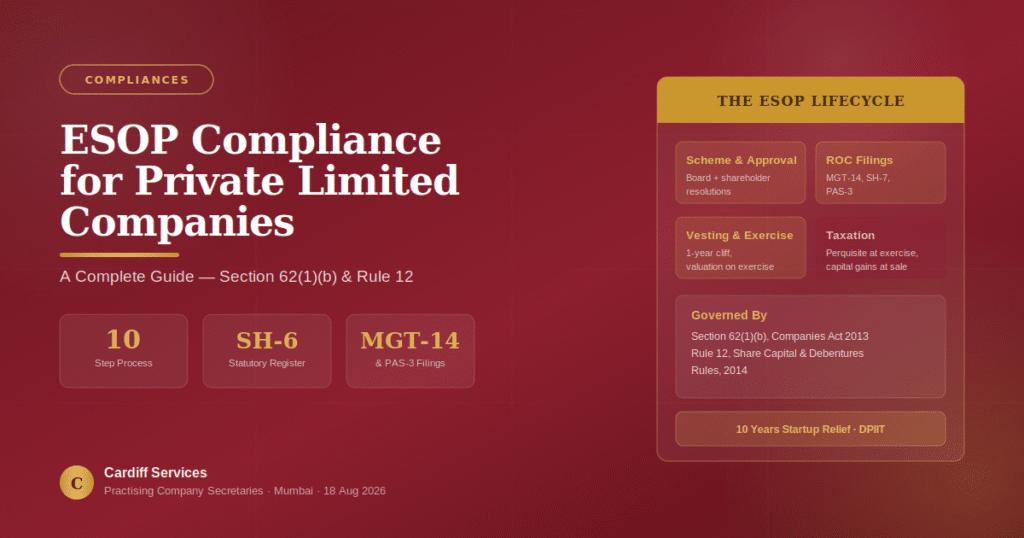
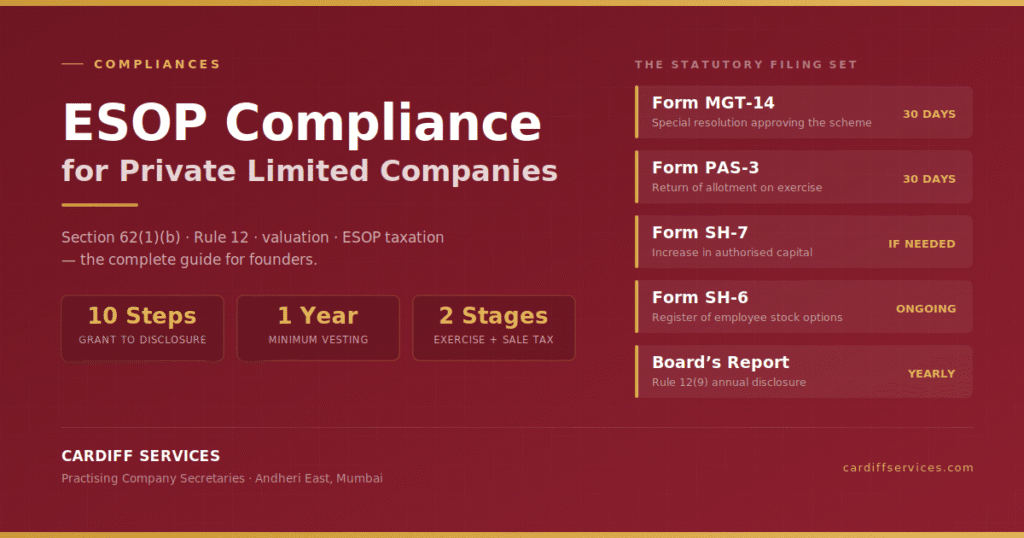
Home / Blog / Compliances / ESOP Compliance for Private Limited Companies Compliances ESOP Compliance for Private Limited Companies: A Complete Guide ~11 min read Cardiff Services 18 August 2026 ESOP Section 62(1)(b) Rule 12 MGT-14 PAS-3 Form SH-6 ESOP Taxation In This Guide 01What ESOP Compliance Means Under Indian Law 02Who Is Eligible to Receive ESOPs 03The 10-Step Compliance Process 04ROC Forms and Registers 05How ESOPs Are Taxed 06Common Compliance Mistakes 07Startups and Foreign-Owned Companies 08How ESOP Regulation Changed Since 1991 09Frequently Asked Questions ESOP compliance for private limited companies is the complete set of statutory steps an unlisted private company must complete under Section 62(1)(b) of the Companies Act, 2013 read with Rule 12 of the Companies (Share Capital and Debentures) Rules, 2014 before, during and after it grants stock options to its people. Those steps run from drafting the scheme and obtaining board and shareholder approval, through filing the prescribed forms with the Registrar of Companies and maintaining the statutory register, to arranging a valuation and deducting tax when options are exercised. Each step carries a legal consequence, and a grant made without them is open to challenge. This matters commercially, not academically. Investors examine the ESOP paper trail closely during due diligence, and a defective scheme weakens the credibility of the option pool, delays term sheets and sometimes forces a fresh round of approvals in the middle of a transaction. Employees, for their part, need certainty on vesting, exercise price and tax before they treat options as real compensation. Getting ESOP compliance for private limited companies right at the start costs a fraction of reconstructing it later under diligence pressure. What Is ESOP Compliance for Private Limited Companies Under Indian Law? ESOP compliance for private limited companies means following Section 62(1)(b) of the Companies Act, 2013 together with Rule 12 of the Companies (Share Capital and Debentures) Rules, 2014, which govern how an unlisted company creates a stock option scheme, grants options and allots shares on exercise. Section 2(37) of the Act defines an employees’ stock option as the option given to a director, officer or employee to purchase or subscribe to the company’s shares at a future date at a pre-determined price. A private company sits outside the SEBI (Share Based Employee Benefits and Sweat Equity) Regulations, 2021, which apply only to listed entities. That does not lighten the burden; it shifts it entirely onto the Companies Act and the income tax law. The practical difference is that no exchange or regulator reviews your scheme in advance. The first serious scrutiny usually arrives from an investor’s counsel or a statutory auditor, at a point where defects are expensive and awkward to cure. Three documents form the spine of the exercise: the ESOP scheme itself, the shareholder resolution approving it, and the grant letters issued to employees. Every filing, register, valuation and disclosure that follows is derived from these three. Our ESOP Scheme Compliance practice handles all of them as a single engagement, which is usually cheaper than assembling them piecemeal across three different advisors. Who Is Eligible to Receive ESOPs in a Private Limited Company? Rule 12(1) permits options to be granted to a permanent employee of the company working in India or outside India, to a director whether whole-time or not, and to a permanent employee or director of the company’s subsidiary or holding company in India or abroad. Independent directors are expressly excluded. Two further exclusions catch most founders by surprise. An employee who is a promoter or belongs to the promoter group cannot receive options. Nor can a director who, either personally, through a relative or through a body corporate, directly or indirectly holds more than ten percent of the outstanding equity shares of the company. These are the ESOP rules for private limited company promoters that most template schemes downloaded from the internet quietly ignore. โ† Scroll to see the full table โ†’ Category Position Under Rule 12(1) What Founders Get Wrong Permanent employees โœ… Eligible, whether working in India or outside India. Employment must be permanent โ€” probationers and fixed-term arrangements need to be checked against the scheme definition. Directors โœ… Eligible, whether whole-time or not. Eligibility ends the moment the ten percent shareholding line is crossed. Group company staff โœ… Permanent employees and directors of a subsidiary or holding company, in India or abroad. A separate shareholder resolution is required for these grants. Independent directors โœ• Expressly excluded, in every case. No startup relief applies โ€” the exclusion is absolute. Promoters and promoter group โœ• Excluded, unless the company is a DPIIT-recognised startup. Template schemes routinely include founders who are promoters, which is the defect diligence finds first. Directors holding >10% โœ• Excluded where more than ten percent of outstanding equity is held directly or indirectly, personally, through a relative or through a body corporate. Indirect holdings through relatives or holding entities are counted, not just shares in the director’s own name. Consultants and advisors โœ• Not eligible โ€” they are neither permanent employees nor directors. Contractors are frequently promised options that cannot lawfully be granted to them. The relief is narrow and specific. Where the company is a startup recognised by the Department for Promotion of Industry and Internal Trade, both exclusions are switched off for ten years from the date of incorporation or registration. That window was originally five years and was extended to ten. If your company is eligible but not yet recognised, Startup India registration should be completed before the grant, not after it. ๐Ÿ“‹ Note โ€” Consultants and Contractors Cannot Be Granted ESOPs Consultants, advisors and independent contractors cannot be granted ESOPs under the Companies Act, 2013, because they are not permanent employees or directors. Companies that want to reward such contributors normally look at sweat equity shares under Section 54, or at a commercial arrangement outside the equity structure altogether. What Is the Step-by-Step Process for ESOP Compliance? The process runs in ten sequential steps, and the order genuinely matters: a grant

DIR-3 KYC Deadline Miss Hone Par Kya Hoga? Penalties, Last Date Aur Filing Process Read More ยป

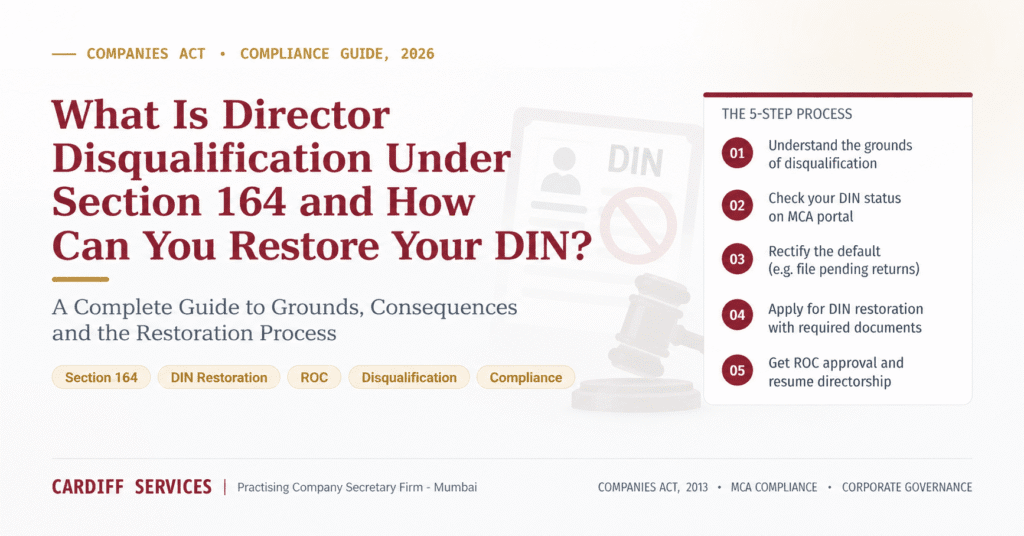
What Is Director Disqualification Under Section 164 and How Can You Restore Your DIN?

Home / Blog / Compliances / ESOP Compliance for Private Limited Companies Compliances ESOP Compliance for Private Limited Companies: A Complete Guide ~11 min read Cardiff Services 18 August 2026 ESOP Section 62(1)(b) Rule 12 MGT-14 PAS-3 Form SH-6 ESOP Taxation In This Guide 01What ESOP Compliance Means Under Indian Law 02Who Is Eligible to Receive ESOPs 03The 10-Step Compliance Process 04ROC Forms and Registers 05How ESOPs Are Taxed 06Common Compliance Mistakes 07Startups and Foreign-Owned Companies 08How ESOP Regulation Changed Since 1991 09Frequently Asked Questions ESOP compliance for private limited companies is the complete set of statutory steps an unlisted private company must complete under Section 62(1)(b) of the Companies Act, 2013 read with Rule 12 of the Companies (Share Capital and Debentures) Rules, 2014 before, during and after it grants stock options to its people. Those steps run from drafting the scheme and obtaining board and shareholder approval, through filing the prescribed forms with the Registrar of Companies and maintaining the statutory register, to arranging a valuation and deducting tax when options are exercised. Each step carries a legal consequence, and a grant made without them is open to challenge. This matters commercially, not academically. Investors examine the ESOP paper trail closely during due diligence, and a defective scheme weakens the credibility of the option pool, delays term sheets and sometimes forces a fresh round of approvals in the middle of a transaction. Employees, for their part, need certainty on vesting, exercise price and tax before they treat options as real compensation. Getting ESOP compliance for private limited companies right at the start costs a fraction of reconstructing it later under diligence pressure. What Is ESOP Compliance for Private Limited Companies Under Indian Law? ESOP compliance for private limited companies means following Section 62(1)(b) of the Companies Act, 2013 together with Rule 12 of the Companies (Share Capital and Debentures) Rules, 2014, which govern how an unlisted company creates a stock option scheme, grants options and allots shares on exercise. Section 2(37) of the Act defines an employees’ stock option as the option given to a director, officer or employee to purchase or subscribe to the company’s shares at a future date at a pre-determined price. A private company sits outside the SEBI (Share Based Employee Benefits and Sweat Equity) Regulations, 2021, which apply only to listed entities. That does not lighten the burden; it shifts it entirely onto the Companies Act and the income tax law. The practical difference is that no exchange or regulator reviews your scheme in advance. The first serious scrutiny usually arrives from an investor’s counsel or a statutory auditor, at a point where defects are expensive and awkward to cure. Three documents form the spine of the exercise: the ESOP scheme itself, the shareholder resolution approving it, and the grant letters issued to employees. Every filing, register, valuation and disclosure that follows is derived from these three. Our ESOP Scheme Compliance practice handles all of them as a single engagement, which is usually cheaper than assembling them piecemeal across three different advisors. Who Is Eligible to Receive ESOPs in a Private Limited Company? Rule 12(1) permits options to be granted to a permanent employee of the company working in India or outside India, to a director whether whole-time or not, and to a permanent employee or director of the company’s subsidiary or holding company in India or abroad. Independent directors are expressly excluded. Two further exclusions catch most founders by surprise. An employee who is a promoter or belongs to the promoter group cannot receive options. Nor can a director who, either personally, through a relative or through a body corporate, directly or indirectly holds more than ten percent of the outstanding equity shares of the company. These are the ESOP rules for private limited company promoters that most template schemes downloaded from the internet quietly ignore. โ† Scroll to see the full table โ†’ Category Position Under Rule 12(1) What Founders Get Wrong Permanent employees โœ… Eligible, whether working in India or outside India. Employment must be permanent โ€” probationers and fixed-term arrangements need to be checked against the scheme definition. Directors โœ… Eligible, whether whole-time or not. Eligibility ends the moment the ten percent shareholding line is crossed. Group company staff โœ… Permanent employees and directors of a subsidiary or holding company, in India or abroad. A separate shareholder resolution is required for these grants. Independent directors โœ• Expressly excluded, in every case. No startup relief applies โ€” the exclusion is absolute. Promoters and promoter group โœ• Excluded, unless the company is a DPIIT-recognised startup. Template schemes routinely include founders who are promoters, which is the defect diligence finds first. Directors holding >10% โœ• Excluded where more than ten percent of outstanding equity is held directly or indirectly, personally, through a relative or through a body corporate. Indirect holdings through relatives or holding entities are counted, not just shares in the director’s own name. Consultants and advisors โœ• Not eligible โ€” they are neither permanent employees nor directors. Contractors are frequently promised options that cannot lawfully be granted to them. The relief is narrow and specific. Where the company is a startup recognised by the Department for Promotion of Industry and Internal Trade, both exclusions are switched off for ten years from the date of incorporation or registration. That window was originally five years and was extended to ten. If your company is eligible but not yet recognised, Startup India registration should be completed before the grant, not after it. ๐Ÿ“‹ Note โ€” Consultants and Contractors Cannot Be Granted ESOPs Consultants, advisors and independent contractors cannot be granted ESOPs under the Companies Act, 2013, because they are not permanent employees or directors. Companies that want to reward such contributors normally look at sweat equity shares under Section 54, or at a commercial arrangement outside the equity structure altogether. What Is the Step-by-Step Process for ESOP Compliance? The process runs in ten sequential steps, and the order genuinely matters: a grant

What Is Director Disqualification Under Section 164 and How Can You Restore Your DIN? Read More ยป

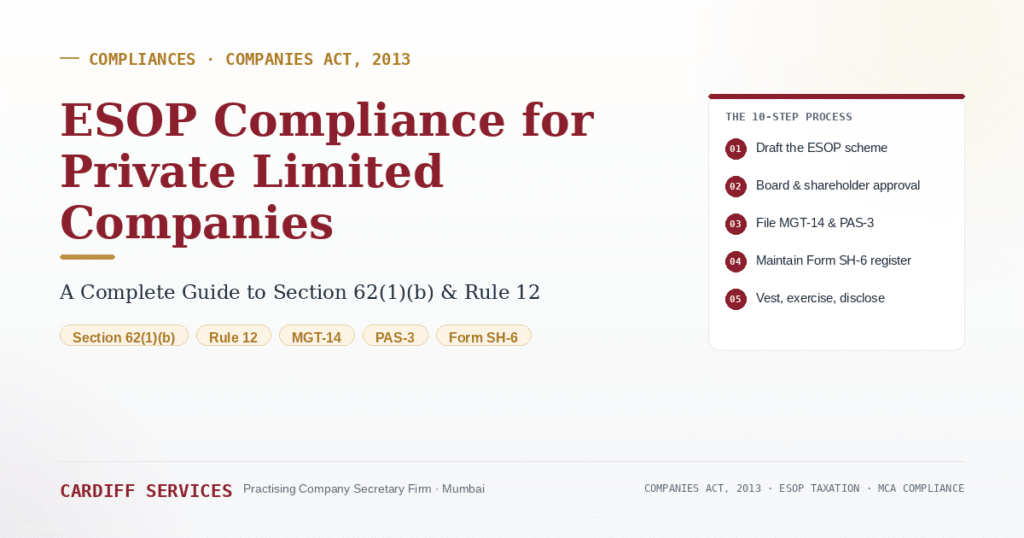
ESOP Compliance for Private Limited Companies: A Complete Guide

Home / Blog / Compliances / ESOP Compliance for Private Limited Companies Compliances ESOP Compliance for Private Limited Companies: A Complete Guide ~11 min read Cardiff Services 18 August 2026 ESOP Section 62(1)(b) Rule 12 MGT-14 PAS-3 Form SH-6 ESOP Taxation In This Guide 01What ESOP Compliance Means Under Indian Law 02Who Is Eligible to Receive ESOPs 03The 10-Step Compliance Process 04ROC Forms and Registers 05How ESOPs Are Taxed 06Common Compliance Mistakes 07Startups and Foreign-Owned Companies 08How ESOP Regulation Changed Since 1991 09Frequently Asked Questions ESOP compliance for private limited companies is the complete set of statutory steps an unlisted private company must complete under Section 62(1)(b) of the Companies Act, 2013 read with Rule 12 of the Companies (Share Capital and Debentures) Rules, 2014 before, during and after it grants stock options to its people. Those steps run from drafting the scheme and obtaining board and shareholder approval, through filing the prescribed forms with the Registrar of Companies and maintaining the statutory register, to arranging a valuation and deducting tax when options are exercised. Each step carries a legal consequence, and a grant made without them is open to challenge. This matters commercially, not academically. Investors examine the ESOP paper trail closely during due diligence, and a defective scheme weakens the credibility of the option pool, delays term sheets and sometimes forces a fresh round of approvals in the middle of a transaction. Employees, for their part, need certainty on vesting, exercise price and tax before they treat options as real compensation. Getting ESOP compliance for private limited companies right at the start costs a fraction of reconstructing it later under diligence pressure. What Is ESOP Compliance for Private Limited Companies Under Indian Law? ESOP compliance for private limited companies means following Section 62(1)(b) of the Companies Act, 2013 together with Rule 12 of the Companies (Share Capital and Debentures) Rules, 2014, which govern how an unlisted company creates a stock option scheme, grants options and allots shares on exercise. Section 2(37) of the Act defines an employees’ stock option as the option given to a director, officer or employee to purchase or subscribe to the company’s shares at a future date at a pre-determined price. A private company sits outside the SEBI (Share Based Employee Benefits and Sweat Equity) Regulations, 2021, which apply only to listed entities. That does not lighten the burden; it shifts it entirely onto the Companies Act and the income tax law. The practical difference is that no exchange or regulator reviews your scheme in advance. The first serious scrutiny usually arrives from an investor’s counsel or a statutory auditor, at a point where defects are expensive and awkward to cure. Three documents form the spine of the exercise: the ESOP scheme itself, the shareholder resolution approving it, and the grant letters issued to employees. Every filing, register, valuation and disclosure that follows is derived from these three. Our ESOP Scheme Compliance practice handles all of them as a single engagement, which is usually cheaper than assembling them piecemeal across three different advisors. Who Is Eligible to Receive ESOPs in a Private Limited Company? Rule 12(1) permits options to be granted to a permanent employee of the company working in India or outside India, to a director whether whole-time or not, and to a permanent employee or director of the company’s subsidiary or holding company in India or abroad. Independent directors are expressly excluded. Two further exclusions catch most founders by surprise. An employee who is a promoter or belongs to the promoter group cannot receive options. Nor can a director who, either personally, through a relative or through a body corporate, directly or indirectly holds more than ten percent of the outstanding equity shares of the company. These are the ESOP rules for private limited company promoters that most template schemes downloaded from the internet quietly ignore. โ† Scroll to see the full table โ†’ Category Position Under Rule 12(1) What Founders Get Wrong Permanent employees โœ… Eligible, whether working in India or outside India. Employment must be permanent โ€” probationers and fixed-term arrangements need to be checked against the scheme definition. Directors โœ… Eligible, whether whole-time or not. Eligibility ends the moment the ten percent shareholding line is crossed. Group company staff โœ… Permanent employees and directors of a subsidiary or holding company, in India or abroad. A separate shareholder resolution is required for these grants. Independent directors โœ• Expressly excluded, in every case. No startup relief applies โ€” the exclusion is absolute. Promoters and promoter group โœ• Excluded, unless the company is a DPIIT-recognised startup. Template schemes routinely include founders who are promoters, which is the defect diligence finds first. Directors holding >10% โœ• Excluded where more than ten percent of outstanding equity is held directly or indirectly, personally, through a relative or through a body corporate. Indirect holdings through relatives or holding entities are counted, not just shares in the director’s own name. Consultants and advisors โœ• Not eligible โ€” they are neither permanent employees nor directors. Contractors are frequently promised options that cannot lawfully be granted to them. The relief is narrow and specific. Where the company is a startup recognised by the Department for Promotion of Industry and Internal Trade, both exclusions are switched off for ten years from the date of incorporation or registration. That window was originally five years and was extended to ten. If your company is eligible but not yet recognised, Startup India registration should be completed before the grant, not after it. ๐Ÿ“‹ Note โ€” Consultants and Contractors Cannot Be Granted ESOPs Consultants, advisors and independent contractors cannot be granted ESOPs under the Companies Act, 2013, because they are not permanent employees or directors. Companies that want to reward such contributors normally look at sweat equity shares under Section 54, or at a commercial arrangement outside the equity structure altogether. What Is the Step-by-Step Process for ESOP Compliance? The process runs in ten sequential steps, and the order genuinely matters: a grant

ESOP Compliance for Private Limited Companies: A Complete Guide Read More ยป

EOP Compliance for Private Limited Companies: A Complete Guide

Home / Blog / Compliances / ESOP Compliance for Private Limited Companies Compliances ESOP Compliance for Private Limited Companies: A Complete Guide ~11 min read Cardiff Services 18 August 2026 ESOP Section 62(1)(b) Rule 12 MGT-14 PAS-3 Form SH-6 ESOP Taxation In This Guide 01What ESOP Compliance Means Under Indian Law 02Who Is Eligible to Receive ESOPs 03The 10-Step Compliance Process 04ROC Forms and Registers 05How ESOPs Are Taxed 06Common Compliance Mistakes 07Startups and Foreign-Owned Companies 08How ESOP Regulation Changed Since 1991 09Frequently Asked Questions ESOP compliance for private limited companies is the complete set of statutory steps an unlisted private company must complete under Section 62(1)(b) of the Companies Act, 2013 read with Rule 12 of the Companies (Share Capital and Debentures) Rules, 2014 before, during and after it grants stock options to its people. Those steps run from drafting the scheme and obtaining board and shareholder approval, through filing the prescribed forms with the Registrar of Companies and maintaining the statutory register, to arranging a valuation and deducting tax when options are exercised. Each step carries a legal consequence, and a grant made without them is open to challenge. This matters commercially, not academically. Investors examine the ESOP paper trail closely during due diligence, and a defective scheme weakens the credibility of the option pool, delays term sheets and sometimes forces a fresh round of approvals in the middle of a transaction. Employees, for their part, need certainty on vesting, exercise price and tax before they treat options as real compensation. Getting ESOP compliance for private limited companies right at the start costs a fraction of reconstructing it later under diligence pressure. What Is ESOP Compliance for Private Limited Companies Under Indian Law? ESOP compliance for private limited companies means following Section 62(1)(b) of the Companies Act, 2013 together with Rule 12 of the Companies (Share Capital and Debentures) Rules, 2014, which govern how an unlisted company creates a stock option scheme, grants options and allots shares on exercise. Section 2(37) of the Act defines an employees’ stock option as the option given to a director, officer or employee to purchase or subscribe to the company’s shares at a future date at a pre-determined price. A private company sits outside the SEBI (Share Based Employee Benefits and Sweat Equity) Regulations, 2021, which apply only to listed entities. That does not lighten the burden; it shifts it entirely onto the Companies Act and the income tax law. The practical difference is that no exchange or regulator reviews your scheme in advance. The first serious scrutiny usually arrives from an investor’s counsel or a statutory auditor, at a point where defects are expensive and awkward to cure. Three documents form the spine of the exercise: the ESOP scheme itself, the shareholder resolution approving it, and the grant letters issued to employees. Every filing, register, valuation and disclosure that follows is derived from these three. Our ESOP Scheme Compliance practice handles all of them as a single engagement, which is usually cheaper than assembling them piecemeal across three different advisors. Who Is Eligible to Receive ESOPs in a Private Limited Company? Rule 12(1) permits options to be granted to a permanent employee of the company working in India or outside India, to a director whether whole-time or not, and to a permanent employee or director of the company’s subsidiary or holding company in India or abroad. Independent directors are expressly excluded. Two further exclusions catch most founders by surprise. An employee who is a promoter or belongs to the promoter group cannot receive options. Nor can a director who, either personally, through a relative or through a body corporate, directly or indirectly holds more than ten percent of the outstanding equity shares of the company. These are the ESOP rules for private limited company promoters that most template schemes downloaded from the internet quietly ignore. โ† Scroll to see the full table โ†’ Category Position Under Rule 12(1) What Founders Get Wrong Permanent employees โœ… Eligible, whether working in India or outside India. Employment must be permanent โ€” probationers and fixed-term arrangements need to be checked against the scheme definition. Directors โœ… Eligible, whether whole-time or not. Eligibility ends the moment the ten percent shareholding line is crossed. Group company staff โœ… Permanent employees and directors of a subsidiary or holding company, in India or abroad. A separate shareholder resolution is required for these grants. Independent directors โœ• Expressly excluded, in every case. No startup relief applies โ€” the exclusion is absolute. Promoters and promoter group โœ• Excluded, unless the company is a DPIIT-recognised startup. Template schemes routinely include founders who are promoters, which is the defect diligence finds first. Directors holding >10% โœ• Excluded where more than ten percent of outstanding equity is held directly or indirectly, personally, through a relative or through a body corporate. Indirect holdings through relatives or holding entities are counted, not just shares in the director’s own name. Consultants and advisors โœ• Not eligible โ€” they are neither permanent employees nor directors. Contractors are frequently promised options that cannot lawfully be granted to them. The relief is narrow and specific. Where the company is a startup recognised by the Department for Promotion of Industry and Internal Trade, both exclusions are switched off for ten years from the date of incorporation or registration. That window was originally five years and was extended to ten. If your company is eligible but not yet recognised, Startup India registration should be completed before the grant, not after it. ๐Ÿ“‹ Note โ€” Consultants and Contractors Cannot Be Granted ESOPs Consultants, advisors and independent contractors cannot be granted ESOPs under the Companies Act, 2013, because they are not permanent employees or directors. Companies that want to reward such contributors normally look at sweat equity shares under Section 54, or at a commercial arrangement outside the equity structure altogether. What Is the Step-by-Step Process for ESOP Compliance? The process runs in ten sequential steps, and the order genuinely matters: a grant

EOP Compliance for Private Limited Companies: A Complete Guide Read More ยป

Startup India Recognition: Eligibility, Process, Benefits and Common Mistakes

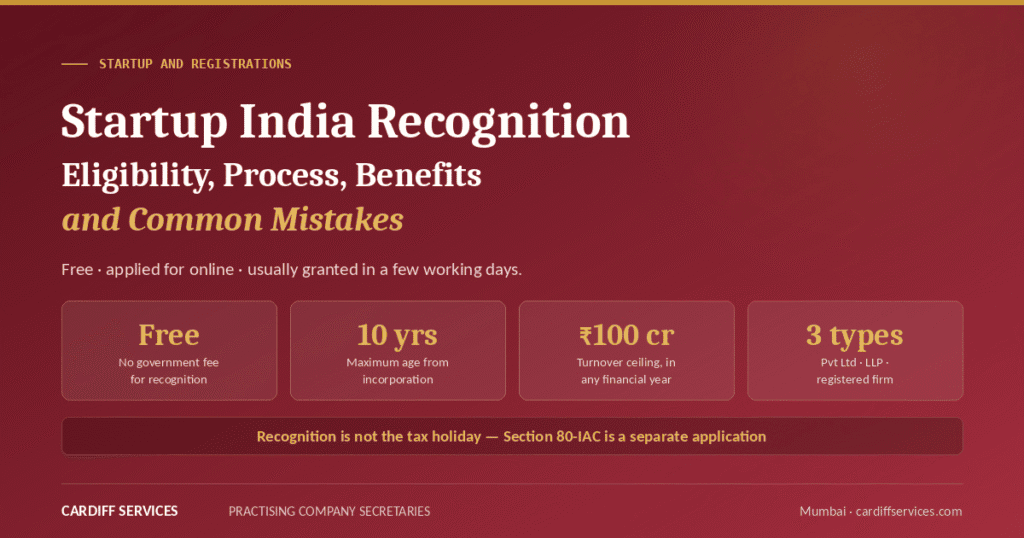
Home / Blog / Start Up / Startup India Recognition Startup and Registrations Startup India Recognition: Eligibility, Process, Benefits and Common Mistakes ~12 min read Cardiff Services 11 August 2026 Startup India DPIIT Recognition Section 80-IAC Seed Fund Scheme LLP Startup Compliance In This Guide 01What Recognition Is and What It Gives You 02Who Is Eligible 03How to Apply: 7-Step Process 04The Real Benefits 05Is Section 80-IAC Automatic? 06Common Mistakes Founders Make 07How Startup Policy Has Changed Since 1991 08Frequently Asked Questions Startup India recognition is a certificate issued by the Department for Promotion of Industry and Internal Trade to an eligible Indian entity, confirming it qualifies as a startup under the government notification and unlocking a defined set of regulatory, tax and procurement benefits. It is free, applied for online, and usually granted within a few working days. Eligible entities are private limited companies, registered partnership firms and limited liability partnerships, within ten years of incorporation and with turnover never having exceeded โ‚น100 crore. What recognition is not is a funding decision, a tax exemption or a licence. Founders regularly conflate all three, apply with the wrong expectations, and either get rejected or get the certificate and then wonder why nothing changed. This guide covers what qualifies, how the application actually runs, which benefits are real, and the specific mistakes that cost applicants time. If you would rather have the application prepared and filed for you, our Startup India registration service does exactly that. What Is Startup India Recognition and What Does It Give You? It is formal recognition of startup status under the Startup India initiative, evidenced by a certificate carrying a DPIIT recognition number. That number is what schemes, tender portals, patent offices and the income tax department look for when a benefit is claimed. The practical value is that recognition converts a general claim into a verifiable status. Without it, a founder telling a government procurement portal that the company is a startup is making an assertion. With it, the entity appears in a recognised register and the exemptions attached to that register apply automatically. Recognition is self-certified in the sense that the applicant declares eligibility rather than proving it exhaustively at the outset. That makes the process fast, and it also makes it worth being accurate, because the declaration stands behind every benefit later claimed on the strength of it. Who Is Eligible for Startup India Recognition? Four conditions must all be satisfied: the right entity type, an age of not more than ten years, turnover that has never exceeded โ‚น100 crore in any financial year, and a genuine innovation or scalability case. A fifth condition operates negatively, disqualifying entities formed by splitting up or reconstructing an existing business. โ† Scroll to see the full table โ†’ Condition What the Rule Requires What Trips Applicants Up Entity type โœ… Private limited company, registered partnership firm or limited liability partnership. A one person company qualifies, because it is incorporated as a private limited company. A sole proprietorship and a public limited company do not qualify. This is where most disqualifications happen. Age โœ… Up to ten years from the date of incorporation or registration. The clock runs from the entity, not from when the founders started working on the idea. Turnover โœ… Must not have exceeded โ‚น100 crore in any financial year since incorporation. Crossing it once is enough to end eligibility permanently, even if turnover later falls back. Innovation or scalability โœ… Working towards innovation, development or improvement of products, processes or services โ€” or a scalable business model with high potential for employment generation or wealth creation. Applications written around the size of the opportunity rather than what the business does differently. Not a reconstruction โœ• An entity formed by splitting up or reconstructing an existing business is excluded. Moving a division of an existing company into a new entity to obtain recognition applies against an express exclusion. The entity type condition has a knock-on effect worth planning for. A founder trading as a proprietor who converts to a private limited company or an LLP starts a fresh ten-year clock from the date of the new entity, which is usually an advantage rather than a loss. ๐Ÿ“‹ Note โ€” How the Innovation Test Is Actually Applied The innovation test is applied to what the entity does, not to how new the sector is. A logistics business with a genuinely different routing method can qualify while a well-funded copy of an existing marketplace may not. Write the application around what is actually different, in specific terms, rather than around how large the opportunity is. How Do You Apply for DPIIT Recognition, Step by Step? Seven steps, of which the first is the one founders skip. Recognition applies to an entity, so the entity must exist and be correctly registered before anything else can begin. 01 Incorporate or register the entity first Complete the private limited company, LLP or partnership firm registration and obtain the certificate of incorporation or registration along with PAN. Recognition cannot be applied for by an unincorporated team, however far advanced the product is. 02 Create a profile on the Startup India portal Register the entity at startupindia.gov.in with a working email address that will remain accessible, because the recognition certificate and all subsequent scheme communication go to it. Use a company address rather than a personal one. 03 Start the recognition application The recognition application is completed online through the government single window route linked from the Startup India portal. The portal architecture has changed more than once since 2016, so start from the official portal rather than from a bookmarked deep link found in an older article. 04 Enter entity and authorised representative details Name, incorporation date, entity type, address, PAN, and the details of every director or partner with their identification. Every field must match the certificate of incorporation exactly. A trading name that differs from the registered name is a common cause of a query. 05 Write

Startup India Recognition: Eligibility, Process, Benefits and Common Mistakes Read More ยป

Mandatory Dematerialisation of Shares for Private Companies

Home / Blog / Mandatory Dematerialisation of Shares Compliance Guide Mandatory Dematerialisation of Shares for Private Companies: Complete Guide ~18 min read Cardiff Services Rule 9B ESOP SME IPO CCPS NBFC Foreign Investment In This Guide 01What Is Rule 9B? 02How Every Corporate Action Changes 03Getting Demat-Ready: 6-Step Process 04Who Needs a Demat Account? 05ESOP Plans and Mandatory Demat 06SME IPO and Mandatory Demat 07CCPS and Convertible Instruments 08Foreign Shareholders 09Penalties for Non-Compliance The Ministry of Corporate Affairs notification that made demat mandatory for private companies from October 2023 changed the mechanics of every transaction that involves shares โ€” not just transfers, but new allotments, ESOP exercises, preference share conversions, rights issues, and even buy-backs. For a startup that has raised multiple rounds from investors holding shares through holding companies, SPVs, and PE funds, the dematerialisation requirement cascades across an entire cap table structure. Every entity that holds shares needs a demat account. Every future allotment must credit to that account. Every transfer must flow through the depository system. For company secretaries and CFOs managing growing companies, Rule 9B of the Companies (Prospectus and Allotment of Securities) Rules, 2014 is now woven into every corporate action. Before you process a new ESOP exercise, you must confirm the employee has a functional demat account. Before your PE investor’s CCPS converts to equity, you must verify their custodian account is in place. Before you file for an SME IPO, every share in the company โ€” promoter, investor, employee โ€” must already be dematerialised. The demat requirement is not a post-transaction cleanup activity. It is a pre-transaction prerequisite. This guide explains exactly how Rule 9B changes each type of corporate action, who specifically needs to open a demat account (and what type), and what startups, PE-backed companies, and SME IPO candidates need to do before their next corporate event. What Is Rule 9B and Which Companies Must Comply? Rule 9B was inserted into the Companies (Prospectus and Allotment of Securities) Rules, 2014 by the MCA on 27 October 2023. It imposes two mandatory requirements on covered private companies: All future securities must be issued only in demat form โ€” from 2 October 2023 onwards, no physical share certificate can be issued by a covered private company for any allotment, rights issue, bonus issue, or ESOP exercise. All existing securities must be dematerialised โ€” the company must facilitate and enable demat for all its existing shares by obtaining an ISIN and entering into agreements with a depository and RTA. Transfers restricted post-deadline: After the compliance date, no transfer of shares in a covered company can be registered unless both parties hold their shares in demat form. Exemption โ€” Small Companies Rule 9B does not apply to small companies under Section 2(85) โ€” those with paid-up capital โ‰ค โ‚น4 crore AND turnover โ‰ค โ‚น40 crore (both conditions simultaneously). If either threshold is exceeded, the company is covered. Status must be reassessed every financial year. How Rule 9B Changes Every Corporate Action โ€” Before and After The most useful way to understand Rule 9B’s practical impact is to see exactly how each corporate action changed after October 2023. The table below maps 8 key corporate events โ€” the old physical-era process against the new Rule 9B compliant process: โ† Scroll to see the full table โ†’ Corporate Action Pre-October 2023 โ€” Physical Era Post-October 2023 โ€” Rule 9B Compliant Share Transfer (between shareholders) Transferor delivers physical share certificate. Transferee signs SH-4 share transfer form. Stamp duty paid on physical instrument. Company registers transfer after verification. Time-intensive โ€” 15 to 30 days. โœ… Both transferor and transferee must hold shares in demat form. Transfer processed electronically through depository โ€” T+1 settlement. Physical SH-4 and certificate delivery no longer accepted for covered companies. ESOP Exercise and Share Allotment Company issued physical share certificates to employees on ESOP exercise. Certificates signed by two directors, stamped, and posted to the employee. ESOP register updated manually. โœ… Employee must have a personal demat account at a Depository Participant (DP). On exercise, shares are credited directly to the employee’s demat account โ€” no physical certificate issued. ESOP compliance must now include DP account verification for all employees before exercise. CCPS / CCD Conversion to Equity On conversion, new equity shares issued via physical certificate to the converting investor. Board resolution for allotment; fresh certificates prepared and dispatched. โœ… Converted equity shares must be credited to the investor’s demat account. If the investor is an entity (PE fund, family office), they must have a valid demat account for the entity. PAS-3 filed for allotment; ISIN used for credit through the depository. Rights Issue Allotment Shareholders could receive new share certificates by post. Those who applied for shares under rights were issued physical certificates. Rights renunciation was a paper-based process. โœ… All rights issue allotments must be credited to shareholders’ demat accounts. Shareholders who wish to renounce rights must do so through the depository. Shareholders without demat accounts cannot receive rights allotment โ€” their rights lapse if they don’t dematerialise first. Bonus Issue Bonus shares issued as physical certificates to existing shareholders. Delivered by registered post. Added to the share certificate folio in the RoM. โœ… Bonus shares credited directly to shareholders’ existing demat accounts. No physical certificate issued. If a shareholder still holds physical shares at the time of the bonus, their physical holding is not augmented unless they dematerialise first โ€” creating an anomaly in the demat-only system. Private Placement to a New Investor New investor paid for shares; company issued a physical share certificate. Investor received the certificate and the share was entered in the Register of Members. โœ… New investor must provide their demat account details at the time of subscribing. Allotment credited to demat account. PAS-3 filed within 30 days of allotment. No physical certificate issued regardless of investor size or type. Buy-Back of Shares Shareholders tendered physical share certificates to the company for buy-back. Certificates verified, cancelled, and the RoM updated. โœ… Buy-back through demat โ€” shares

Mandatory Dematerialisation of Shares for Private Companies Read More ยป

SBO Compliance Under Section 90: Who Must File and How

Home / Blog / SBO Compliance Under Section 90 Compliance Guide SBO Compliance Under Section 90: Who Must File and How ~19 min read Cardiff Services Section 90 SBO BEN Forms PE/VC NBFC M&A In This Guide 01What Is Section 90? 02When the 10% Threshold Applies 03Member Type Decision Matrix 04The Four BEN Forms 05Step-by-Step Compliance Process 06SBO Across Business Stages 07SBO and PE/VC Fund Structures 08NBFC Dual Compliance (SBO + UBO) 09Penalties for Non-Compliance 10Common Compliance Mistakes 11Frequently Asked Questions Every time a startup raises a funding round from an angel investor who subscribes through a personal holding company โ€” or receives a Series A from a PE fund investing via a Mauritius SPV โ€” two compliance obligations arise simultaneously: FEMA and RBI on one side, and Section 90 of the Companies Act on the other. The FEMA side gets attention. The Section 90 Significant Beneficial Owner (SBO) compliance is frequently overlooked until a secretarial audit, a pre-IPO due diligence, or an MCA inspection surfaces the gap. Section 90 requires companies to look through entity layers to identify the ultimate individual natural person who beneficially owns or controls 10% or more of the company’s shares. For a company whose shareholders are entirely individuals holding shares in their own names, there is nothing to do. But the moment a corporate entity, trust, HUF, LLP, or foreign SPV appears in the Register of Members, the SBO analysis begins โ€” and it must be documented with the right BEN forms filed with both the company and the Registrar of Companies. This guide is written for CS professionals, startup founders, CFOs, and compliance teams managing companies with layered ownership structures โ€” PE-backed startups, NBFC groups, foreign-invested Indian companies, and pre-IPO entities. It maps the SBO obligation by member type, by business stage, and by the specific challenges that arise at each stage of a company’s growth. What Is Section 90 and Why Was It Introduced? Section 90 of the Companies Act, 2013 was introduced as part of India’s commitment to corporate transparency and anti-money-laundering norms under FATF (Financial Action Task Force) recommendations. The section operationalized the concept of beneficial ownership disclosure โ€” requiring companies to look through nominee holders and shell structures to identify and register the ultimate natural persons who control or benefit from the company’s shares. Notified under: Companies (Significant Beneficial Owners) Rules, 2018 (June 2018), significantly amended by Companies (Significant Beneficial Owners) Amendment Rules, 2019 (July 2019). Applies to: All companies incorporated under the Companies Act, 2013 โ€” private limited, public limited, OPC, small company โ€” with any non-individual member. Threshold: 10% beneficial interest โ€” in shares, voting rights, or distributable dividend โ€” held directly or indirectly through one or more entity layers. Who is an SBO: Only an individual (natural person) can be an SBO โ€” companies, trusts, HUFs, and LLPs are intermediaries, not SBOs themselves. What must be filed: Form BEN-1 by the SBO with the company โ†’ Form BEN-2 by the company with the ROC โ†’ Form BEN-3 register maintained at the company โ†’ Form BEN-4 notice issued by company to potential SBOs. Legal Reference Section 90 of the Companies Act, 2013 read with Companies (Significant Beneficial Owners) Rules, 2018 and Amendment Rules, 2019. MCA has also issued FAQs and clarifications on specific applicability scenarios. When Does the 10% SBO Threshold Apply โ€” What Counts? An individual meets the SBO threshold if they hold or are entitled to any of the following at 10% or more level, directly or indirectly through one or more entities: Shares or voting rights: 10% or more of the total shares or voting rights in the company. Distributable dividend: 10% or more right to receive or participate in distributable dividends or any other distribution. Significant influence or control: Right to exercise, or actually exercises, significant influence or control โ€” even if equity ownership is below 10%. This is the catch-all provision covering veto rights in SHA, board appointment rights, and reserved matter controls. For indirect holdings, the calculation is proportionate: an individual owning 60% of Company A, which holds 20% in Company B, has an indirect beneficial interest of 12% in Company B (60% ร— 20%) โ€” exceeding the 10% threshold and making them an SBO of Company B. Member Type โ†’ SBO Analysis: Complete Decision Matrix The starting point for every SBO compliance exercise is the Register of Members. For each member, the question is: is this member a natural individual holding directly (no SBO analysis needed) or is it an entity through which an individual may hold beneficial interest (SBO analysis required)? The table below maps every common member type: โ† Scroll to see the full table โ†’ Member Type in Register SBO Analysis Needed? Who to Identify as SBO Common Business Context in India Individual (natural person) โŒ No N/A โ€” individual is already the beneficial owner Founder/promoter holds shares in their own name. Angel investor subscribes directly. No entity layer โ€” no look-through required. Indian Holding / Parent Company โœ… Yes Individual(s) holding โ‰ฅ10% in the holding company OR who control/exercise significant influence over it Promoter group holds the operating company through a promoter holding company. Very common in family businesses and structured startup groups. Foreign Company / Foreign Holding Entity โœ… Yes Ultimate individual foreign promoter or owner of the foreign entity with โ‰ฅ10% indirect interest in the Indian company FDI received from a Mauritius/Singapore/Cayman SPV. The individual behind the SPV must be identified. This is the most common SBO scenario in foreign-invested Indian companies. HUF (Hindu Undivided Family) โœ… Yes Karta of the HUF โ€” the individual who manages and controls the HUF’s affairs and assets Family business where the patriarch’s HUF holds shares in the family company. The Karta files BEN-1 as the SBO. Partnership Firm or LLP โœ… Yes Partner(s) whose indirect beneficial interest in the company is โ‰ฅ10% (computed proportionately) Professional services firms or legacy partnerships that hold equity in portfolio companies. Each partner’s proportionate indirect share is calculated. Listed Indian Company

SBO Compliance Under Section 90: Who Must File and How Read More ยป