ESOP Compliance for Private Limited Companies: A Complete Guide
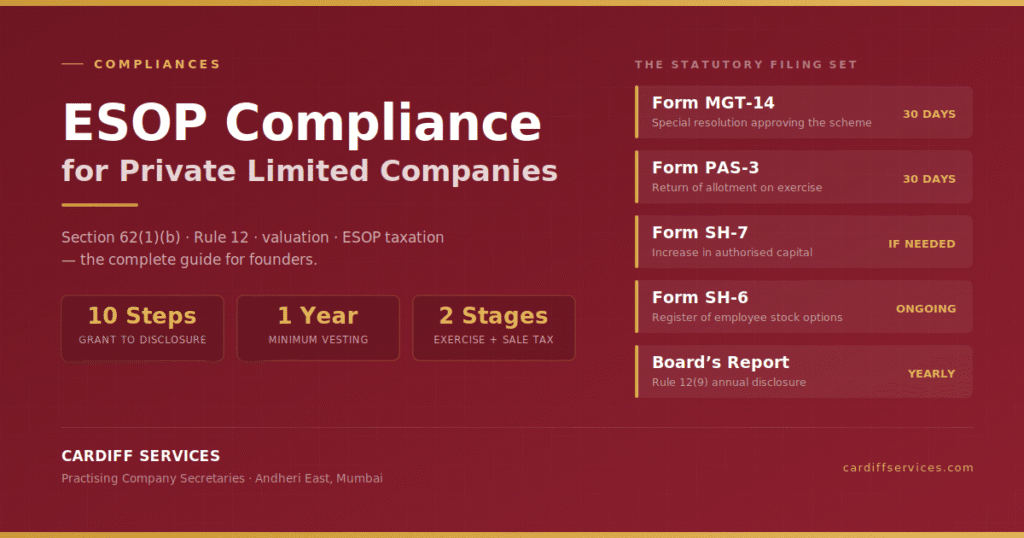
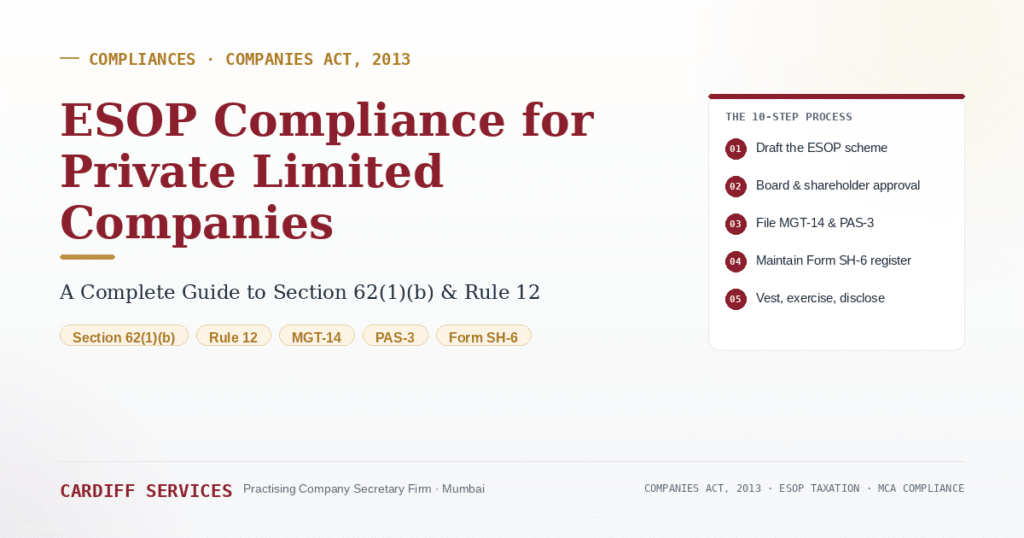
Home / Blog / Compliances / ESOP Compliance for Private Limited Companies Compliances ESOP Compliance for Private Limited Companies: A Complete Guide ~11 min read Cardiff Services 18 August 2026 ESOP Section 62(1)(b) Rule 12 MGT-14 PAS-3 Form SH-6 ESOP Taxation In This Guide 01What ESOP Compliance Means Under Indian Law 02Who Is Eligible to Receive ESOPs 03The 10-Step Compliance Process 04ROC Forms and Registers 05How ESOPs Are Taxed 06Common Compliance Mistakes 07Startups and Foreign-Owned Companies 08How ESOP Regulation Changed Since 1991 09Frequently Asked Questions ESOP compliance for private limited companies is the complete set of statutory steps an unlisted private company must complete under Section 62(1)(b) of the Companies Act, 2013 read with Rule 12 of the Companies (Share Capital and Debentures) Rules, 2014 before, during and after it grants stock options to its people. Those steps run from drafting the scheme and obtaining board and shareholder approval, through filing the prescribed forms with the Registrar of Companies and maintaining the statutory register, to arranging a valuation and deducting tax when options are exercised. Each step carries a legal consequence, and a grant made without them is open to challenge. This matters commercially, not academically. Investors examine the ESOP paper trail closely during due diligence, and a defective scheme weakens the credibility of the option pool, delays term sheets and sometimes forces a fresh round of approvals in the middle of a transaction. Employees, for their part, need certainty on vesting, exercise price and tax before they treat options as real compensation. Getting ESOP compliance for private limited companies right at the start costs a fraction of reconstructing it later under diligence pressure. What Is ESOP Compliance for Private Limited Companies Under Indian Law? ESOP compliance for private limited companies means following Section 62(1)(b) of the Companies Act, 2013 together with Rule 12 of the Companies (Share Capital and Debentures) Rules, 2014, which govern how an unlisted company creates a stock option scheme, grants options and allots shares on exercise. Section 2(37) of the Act defines an employees’ stock option as the option given to a director, officer or employee to purchase or subscribe to the company’s shares at a future date at a pre-determined price. A private company sits outside the SEBI (Share Based Employee Benefits and Sweat Equity) Regulations, 2021, which apply only to listed entities. That does not lighten the burden; it shifts it entirely onto the Companies Act and the income tax law. The practical difference is that no exchange or regulator reviews your scheme in advance. The first serious scrutiny usually arrives from an investor’s counsel or a statutory auditor, at a point where defects are expensive and awkward to cure. Three documents form the spine of the exercise: the ESOP scheme itself, the shareholder resolution approving it, and the grant letters issued to employees. Every filing, register, valuation and disclosure that follows is derived from these three. Our ESOP Scheme Compliance practice handles all of them as a single engagement, which is usually cheaper than assembling them piecemeal across three different advisors. Who Is Eligible to Receive ESOPs in a Private Limited Company? Rule 12(1) permits options to be granted to a permanent employee of the company working in India or outside India, to a director whether whole-time or not, and to a permanent employee or director of the company’s subsidiary or holding company in India or abroad. Independent directors are expressly excluded. Two further exclusions catch most founders by surprise. An employee who is a promoter or belongs to the promoter group cannot receive options. Nor can a director who, either personally, through a relative or through a body corporate, directly or indirectly holds more than ten percent of the outstanding equity shares of the company. These are the ESOP rules for private limited company promoters that most template schemes downloaded from the internet quietly ignore. ← Scroll to see the full table → Category Position Under Rule 12(1) What Founders Get Wrong Permanent employees ✅ Eligible, whether working in India or outside India. Employment must be permanent — probationers and fixed-term arrangements need to be checked against the scheme definition. Directors ✅ Eligible, whether whole-time or not. Eligibility ends the moment the ten percent shareholding line is crossed. Group company staff ✅ Permanent employees and directors of a subsidiary or holding company, in India or abroad. A separate shareholder resolution is required for these grants. Independent directors ✕ Expressly excluded, in every case. No startup relief applies — the exclusion is absolute. Promoters and promoter group ✕ Excluded, unless the company is a DPIIT-recognised startup. Template schemes routinely include founders who are promoters, which is the defect diligence finds first. Directors holding >10% ✕ Excluded where more than ten percent of outstanding equity is held directly or indirectly, personally, through a relative or through a body corporate. Indirect holdings through relatives or holding entities are counted, not just shares in the director’s own name. Consultants and advisors ✕ Not eligible — they are neither permanent employees nor directors. Contractors are frequently promised options that cannot lawfully be granted to them. The relief is narrow and specific. Where the company is a startup recognised by the Department for Promotion of Industry and Internal Trade, both exclusions are switched off for ten years from the date of incorporation or registration. That window was originally five years and was extended to ten. If your company is eligible but not yet recognised, Startup India registration should be completed before the grant, not after it. 📋 Note — Consultants and Contractors Cannot Be Granted ESOPs Consultants, advisors and independent contractors cannot be granted ESOPs under the Companies Act, 2013, because they are not permanent employees or directors. Companies that want to reward such contributors normally look at sweat equity shares under Section 54, or at a commercial arrangement outside the equity structure altogether. What Is the Step-by-Step Process for ESOP Compliance? The process runs in ten sequential steps, and the order genuinely matters: a grant
ESOP Compliance for Private Limited Companies: A Complete Guide Read More »